Comparison
Martech Stack Builder vs Lucidchart
Lucidchart is a powerful professional diagramming tool. But for Martech stack architecture, you need a purpose-built tool with vendor data, AI evaluation, and procurement workflows.
The quick verdict
Lucidchart excels at professional technical diagramming -- flowcharts, UML, network diagrams, and enterprise architecture. It's a polished tool with deep shape libraries, Visio compatibility, and data linking. But when it comes to Martech stack architecture, you get blank shapes with no vendor context, no AI evaluation, and no procurement workflows.
Martech Stack Builder is purpose-built for this exact use case: 100+ pre-built vendor nodes with logos and metadata, AI that evaluates your stack architecture, multi-lens views for data flow and cost analysis, and RFI generation for vendor procurement.
Feature Comparison
| Feature | Martech Stack Builder | Lucidchart |
|---|---|---|
| 100+ Martech vendor library | ✓ | — |
| Pre-built vendor logos & metadata | ✓ | — |
| AI Stack Evaluation (A-F grades) | ✓ | — |
| AI diagram generation | ✓ | — |
| Multi-Lens Views (data flow, cost, consent) | ✓ | — |
| RFI Generator for vendor procurement | ✓ | — |
| Vendor scoring & comparison | ✓ | — |
| Drag-and-drop canvas | ✓ | ✓ |
| Shape libraries & templates | Martech-focused | 1,000+ |
| UML & technical diagrams | — | ✓ |
| Visio import/export | — | ✓ |
| Data linking from external sources | — | ✓ |
| Free tier | ✓ | ✓ |
| Export (PNG, PDF, JSON) | ✓ | ✓ |
Why Martech teams choose Stack Builder
100+ vendor nodes vs generic shapes
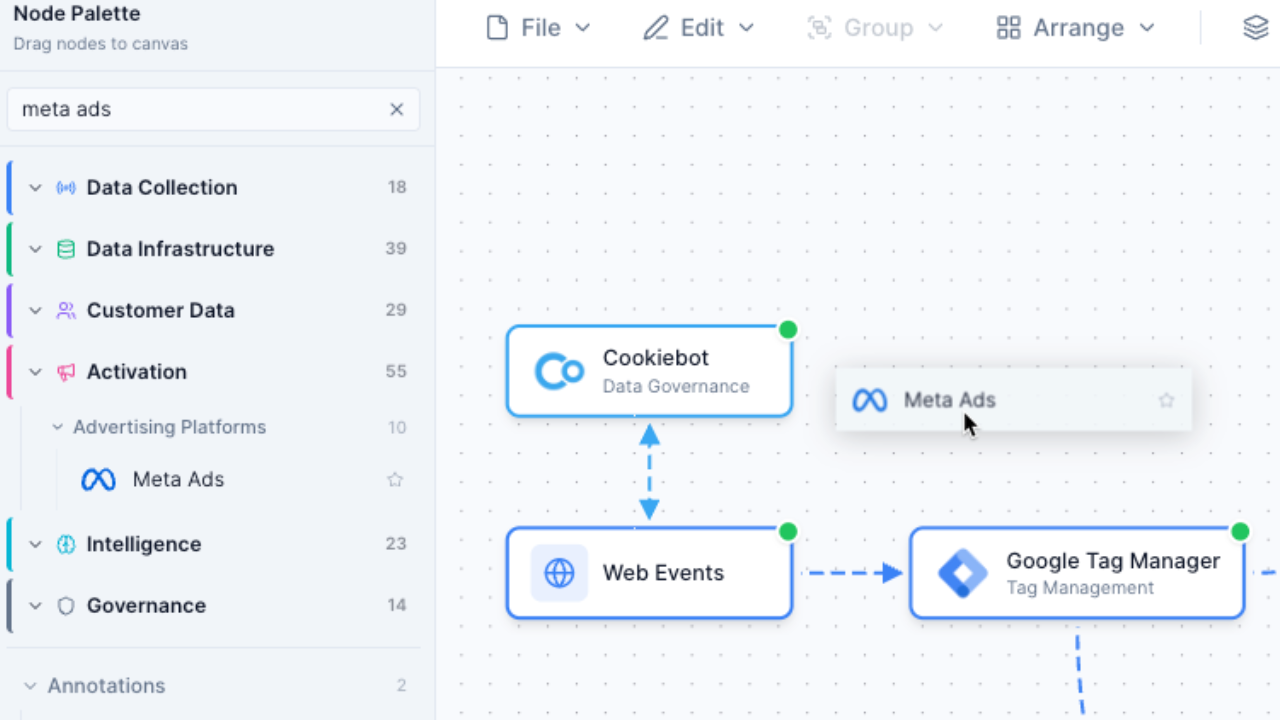
Lucidchart has an impressive library of 1,000+ shapes for flowcharts, UML, and network diagrams -- but none are Martech vendors. Mapping your stack means dragging generic rectangles, searching for vendor logos online, and manually adding metadata. In Stack Builder, you drag pre-built vendor nodes with logos, categories, and integration data already included.
- Pre-built nodes for Segment, HubSpot, Salesforce, and 100+ more
- Vendor logos, categories, and integration data included
- Smart search by name, category, or function
AI-powered evaluation vs manual review
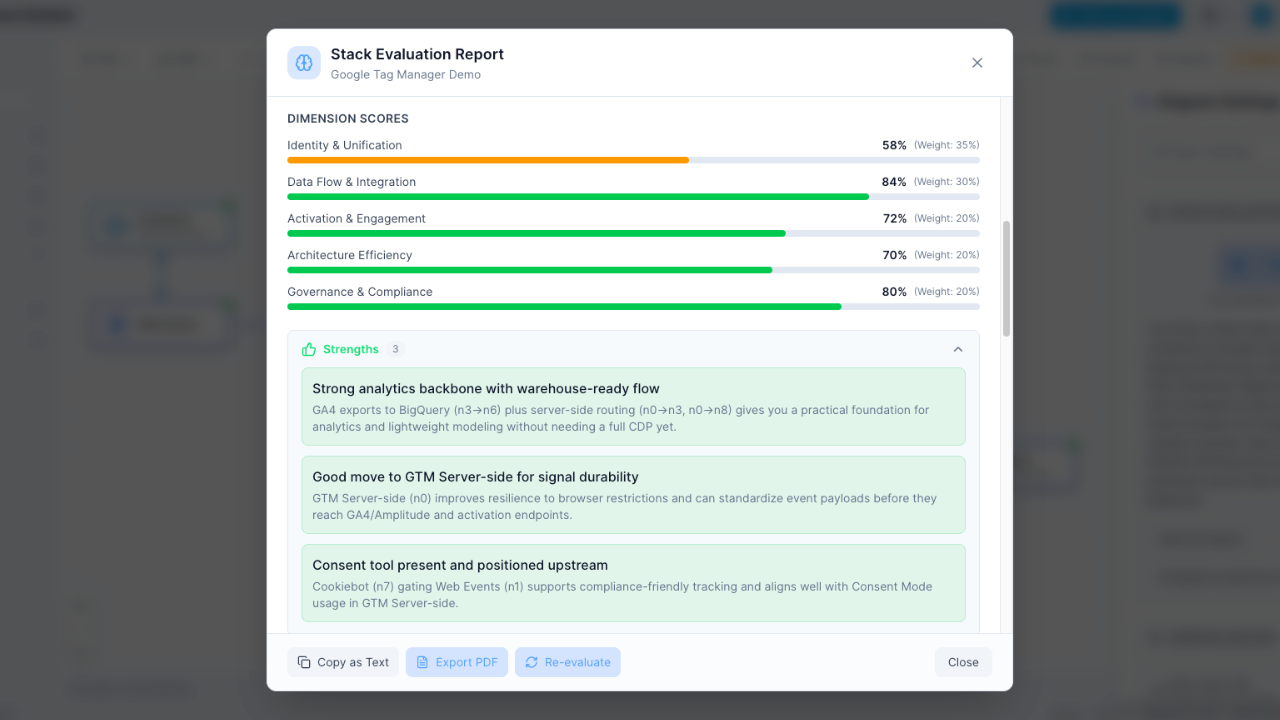
Lucidchart can visualize your stack, but it can't tell you if your architecture is sound. Stack Builder's AI evaluates your stack across Integration Health, Data Governance, Cost Efficiency, Scalability, and Security -- then gives you a letter grade and actionable recommendations. No manual analysis spreadsheets needed.
- Instant A-F letter grades for your stack
- 5-dimension scoring with detailed breakdown
- Actionable recommendations to improve your architecture
Multi-lens views vs single diagram
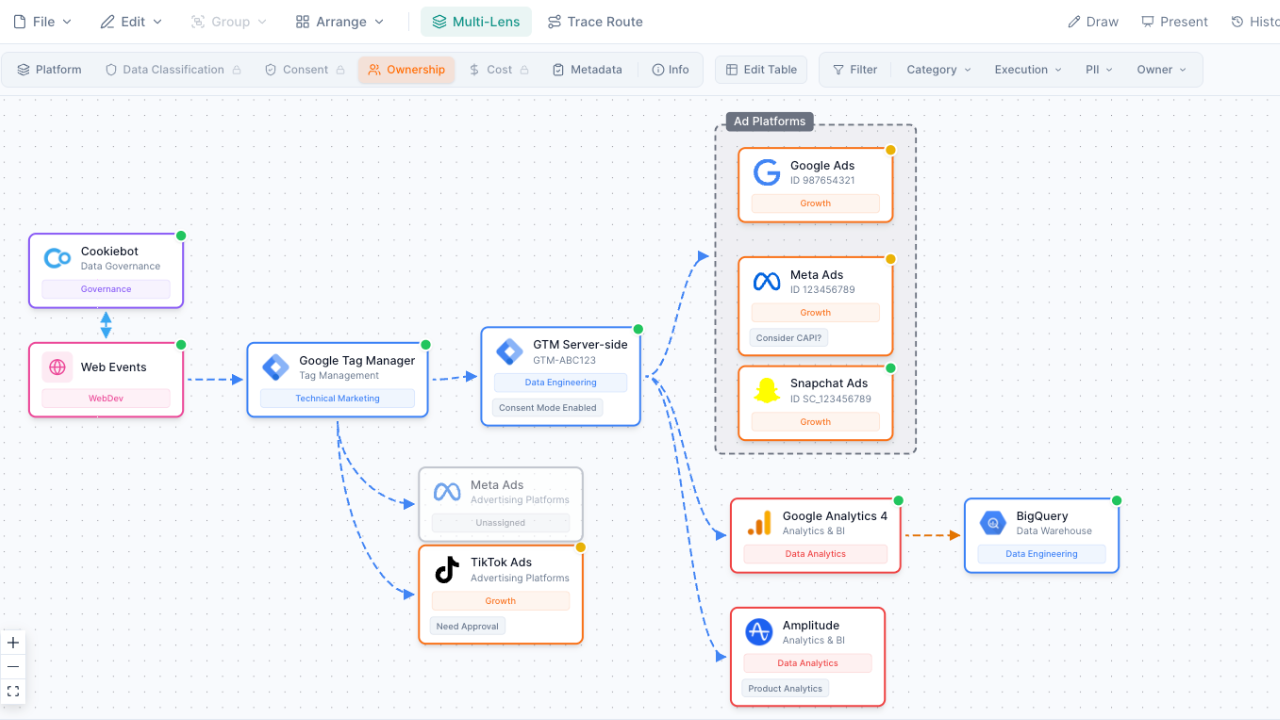
Lucidchart gives you one view of your diagram -- you'd need to create separate pages or layers to show different perspectives. Stack Builder lets you switch between 5 analytical lenses: Platform Architecture, Team Ownership, Data Classification, Consent Governance, and Cost Analysis. Each lens reveals different insights without duplicating your work.
- See who owns each tool with the Ownership lens
- Track data classification and PII exposure
- Visualize cost distribution across your stack
Vendor procurement workflows built in
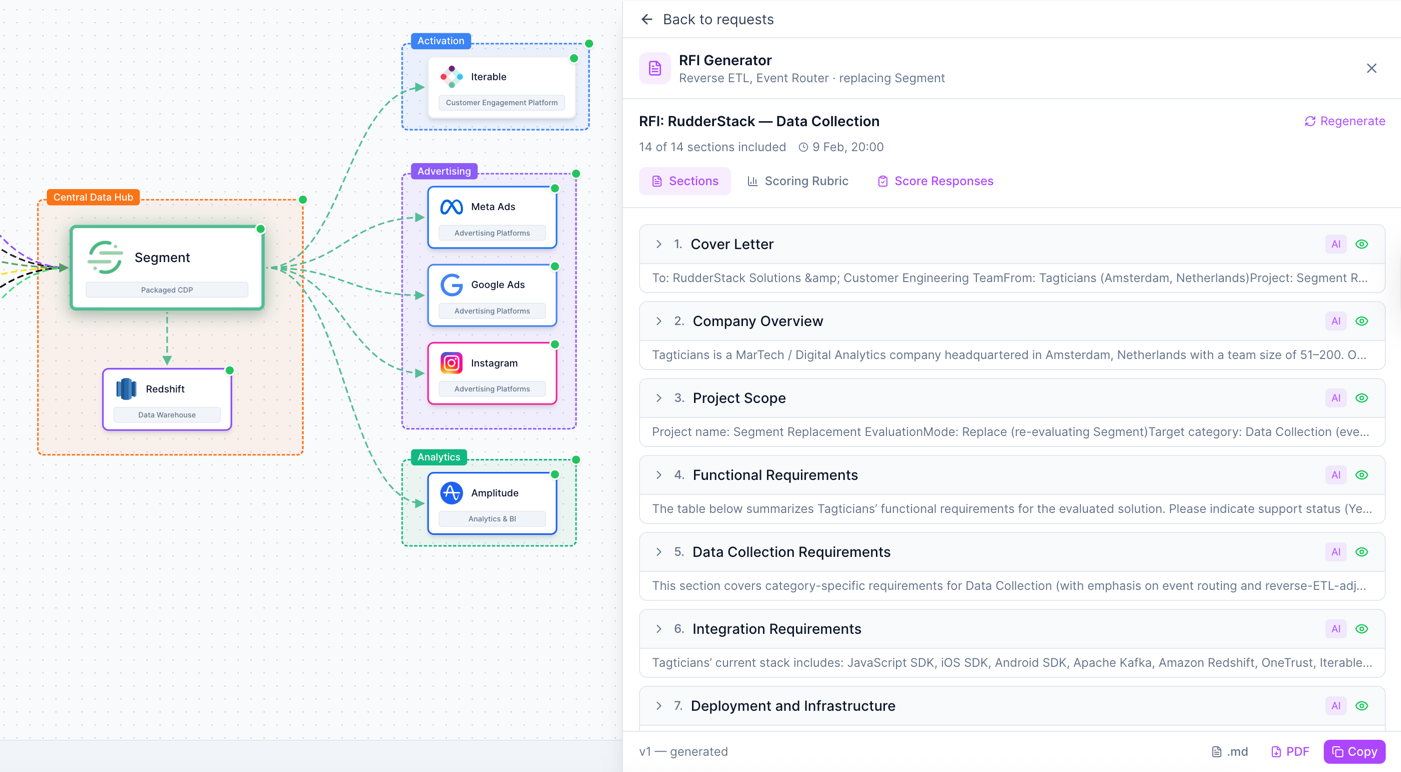
Stack Builder goes beyond visualization. Generate professional RFI documents, score vendor responses against weighted criteria, and build team consensus with side-by-side comparisons. In Lucidchart, you'd need separate spreadsheets, documents, and scoring templates for all of this.
- 10-step guided RFI questionnaire
- AI-generated evaluation documents with scoring rubrics
- Side-by-side vendor comparison with team consensus
When to use Lucidchart instead
Lucidchart is an excellent tool for many use cases. Choose Lucidchart when you need:
- Complex technical diagrams -- UML class diagrams, ERDs, network topology maps, and sequence diagrams
- Enterprise architecture frameworks -- TOGAF, ArchiMate, and other standardized modeling notations
- Visio replacement -- seamless import/export of Visio files with full compatibility
- Non-Martech process flows -- business process mapping, swimlane diagrams, and workflow automation design
But when the task is specifically Martech stack architecture -- mapping your tools, evaluating your stack, and managing vendor decisions -- Martech Stack Builder gives you the specialized features Lucidchart doesn't have.
Frequently Asked Questions
Can Lucidchart map Martech stacks?
Does Lucidchart have AI evaluation?
Which is better for presentations?
Can I import Lucidchart diagrams into Martech Stack Builder?
How does pricing compare?
Is Lucidchart better for large teams?
See the difference for yourself
Build your first Martech stack in minutes with 100+ pre-built vendor nodes, AI evaluation, and multi-lens analysis.
No credit card required. Free plan available.